
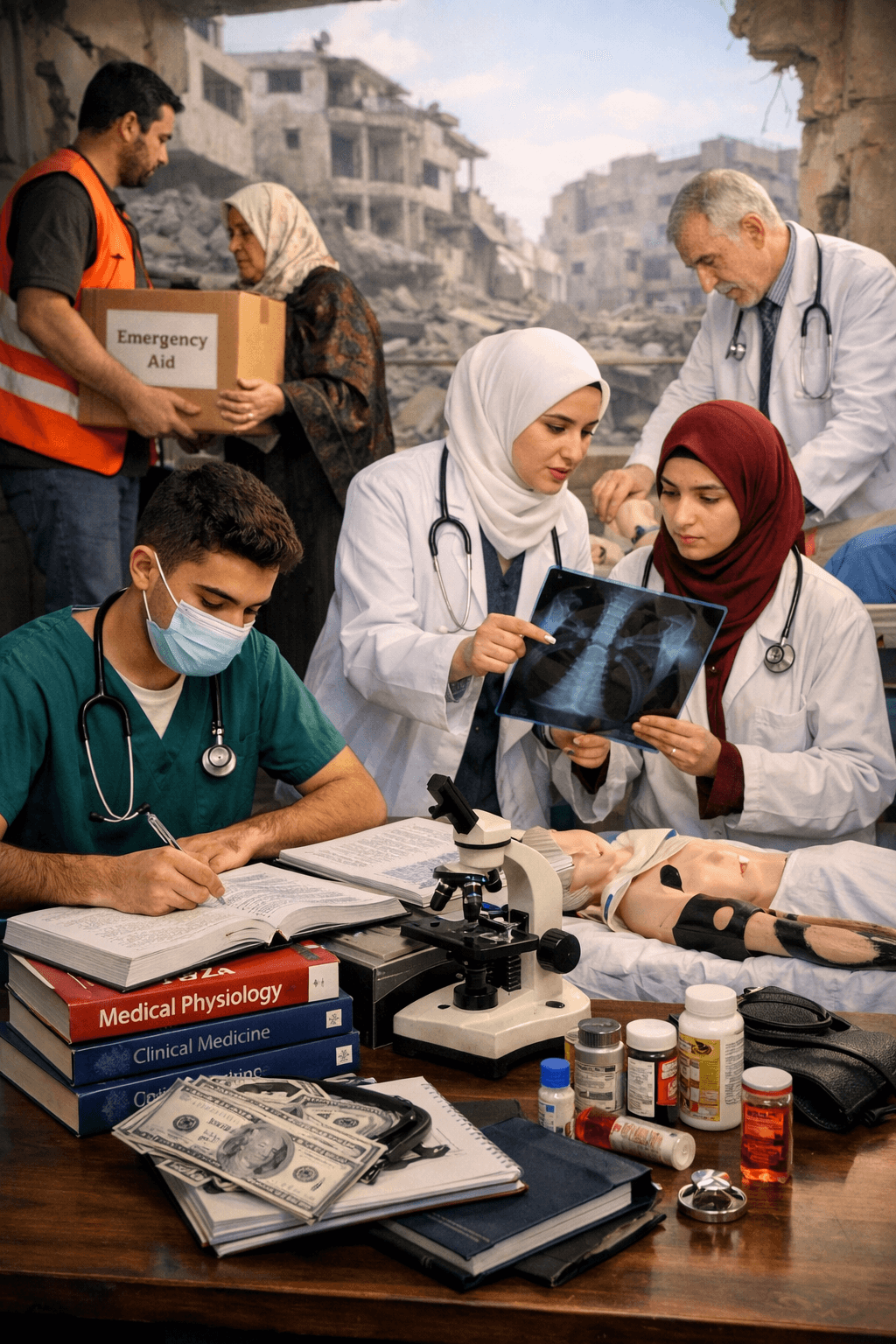
Palestinian education — resilience in the face of erasure
Amid bombardment, siege, displacement and arrest, Palestinian education faces profound existential challenges that threaten its very continuity. Yet it stands as a powerful symbol of resilience and knowledge in the face of systematic exclusion and deliberate destruction.
Reality and Challenges
Despite the occupation and its restrictions on movement and resources, higher education in Palestine has remained a cornerstone of resilience and capacity building. Since the Nakba, Palestine has graduated thousands of academics and built an advanced educational system. Today more than 50 institutions serve over 210,000 students each year, yet the academic journey faces serious challenges — Israeli restrictions, the arrest of students and academics, and the destruction of infrastructure — a crisis made far more acute by the humanitarian catastrophe in Gaza since October 2023.
Making a Real Difference in Gaza
Repeated Arrests
Since October 2023, over 12,100 arrests have been recorded in the West Bank and Jerusalem — including 795 children and more than 440 women — forcing students to miss school and university for extended periods, especially during exams.
Targeting Students & Faculty
In Gaza over 12,800 students have been killed and more than 20,000 injured, alongside 760 teachers and educational staff, while universities and schools have been heavily bombed, damaging over 1,800 educational facilities.
Destruction of Infrastructure
In 2024, over 800 educational institutions were destroyed — 137 completely and 357 partially. Every university in Gaza was targeted, with 51 university buildings and 57 schools fully demolished, leaving over 350,000 students without access to education.
Suspension of Schooling
More than 700,000 students in Gaza have been cut off from education, with 563 schools closed and around 39,000 students unable to sit their final exams, while over 70% of children are estimated to need psychological support.
The Foundation’s Areas of Work
Education Rates
Nearly 47% of Palestinian youth are enrolled in universities, yet movement restrictions, security barriers and economic hardship block equal access — especially in Gaza, where poverty exceeds 65%.
Illiteracy
Per 2024 data from the Palestinian Central Bureau of Statistics, illiteracy stands at about 3.2% — one of the lowest in the Arab region — thanks to sustained programs and community initiatives, though vulnerable groups in Gaza remain at risk.
Specializations Needed
In 2024, 70% of youth lack basic digital skills, calling for urgent investment in cybersecurity, renewable energy and crisis management to meet labour-market demands.
Economic Conditions
Education faces a multifaceted crisis driven by occupation, blockade and division, which has constrained resources and deepened poverty — making tuition, books and transport unaffordable and forcing many to pause or abandon their studies.
Assassination of Palestinian Academics
During the recent war, Israeli forces assassinated a large number of Palestinian academics, professors and university leaders. A sample of the martyrs and their positions:
﴿وَلَا تَحْسَبَنَّ الَّذِينَ قُتِلُوا فِي سَبِيلِ اللَّهِ أَمْوَاتًا﴾